

How does Additive Manufacturing work?
- In the case of metal powders, additive manufacturing begins with a scan of an object or a completely digital rendering of a desired part.
- The 3D rendered part can be tested in a CAD program tuned digitally.
- Then the 3D rendered part is sent to an additive manufacturing machine.
- The additive manufacturing machine selectively creates layers of metal according to the 3DP. As successive layers are formed on the previous ones, the bed is lowered within the machine.
- Finally, a finished part is produced. The finished product may only need minor finishing to produce the end part. As well, mechanical mechanisms are already functionally part of the finished product. The powder that was not used in the process, in many cases, can be recycled into the machine for the next part. This helps with reducing overall material costs.
Additive manufacturing technologies can be best defined as the techniques that work on the basis of the addition of material rather than subtraction.
Additive manufacturing is a principle, not a technique, and the equipment based on this principle are called additive manufacturing technologies.
Names such as freeform fabrication, rapid prototyping, Additive manufacturing , additive process, rapid manufacturing, layered manufacturing, and all these names are synonymous and the most widely used is Additive manufacturing .
The Additive manufacturing technique has more than 25 years of history.
Additive manufacturing has had a great amount of interest from industry and consumers, and thus development of these machines has expanded and is projected to grow even more rapidly in the near future.
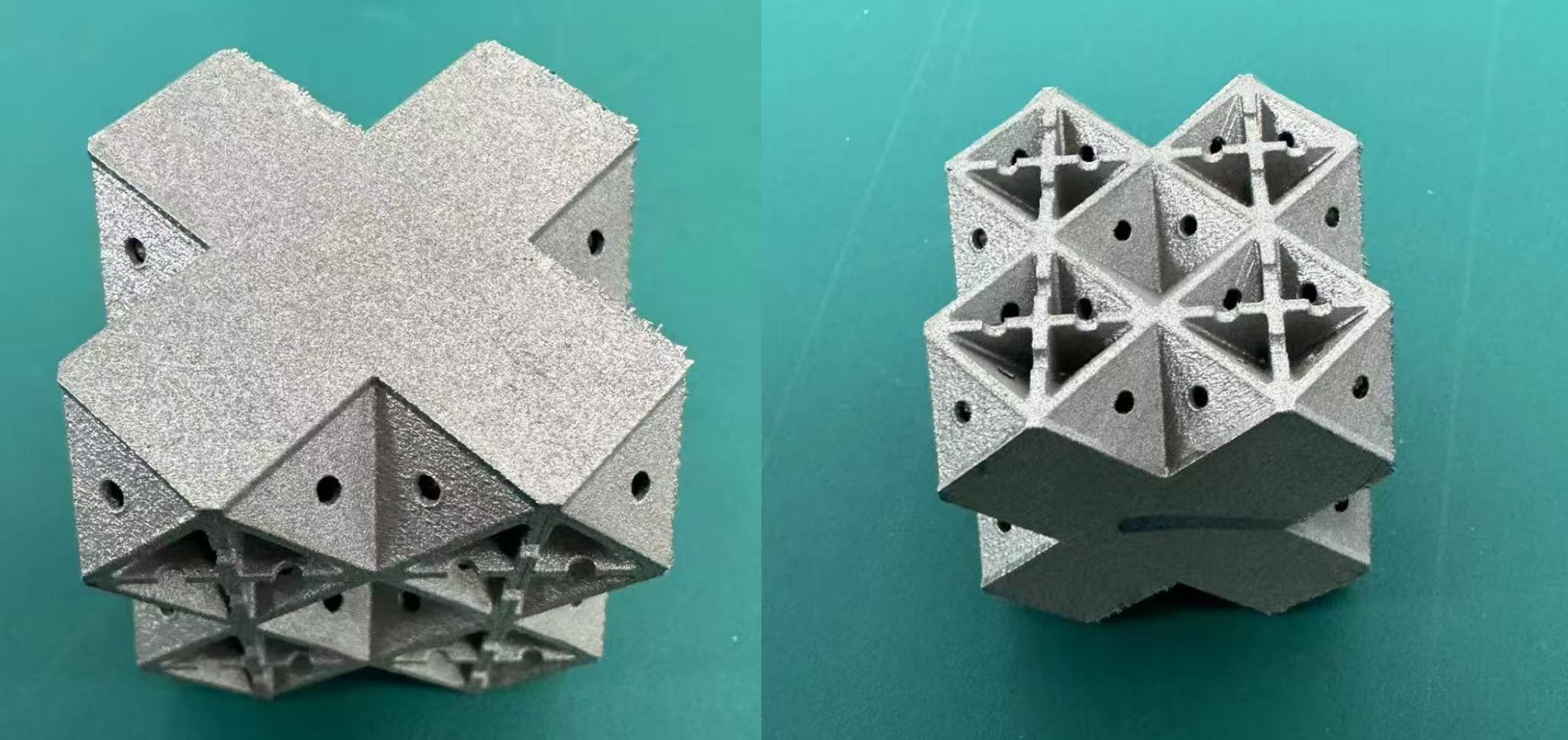
The freedom to produce small complex parts that can have internal channels and mechanisms was for the most part not previously possible.
Advantages
- produce parts that have complicated geometries and complex internal workings.
- AM allows for the creation of parts that cannot be replicated any other way.
- Small production batches are possible
- The use of complex geometries allows for lighter parts that have no loss in strength to be made.
- Intricate cooling channels can be added directly into the part.
- Allowing for the creation of economical custom made products.
- Reduces waste
- True design freedom.
Application
Medical devices and implants can be custom made to fit the patients’ unique forms. Additive manufacturing manufacturing also offers the ability to build implants that are biomedically compatible with living tissue. This comes both from the materials used, and the ability of Additive manufacturing to produce microstructures and meshes with interconnected porosities that allow for better tissue growth and improved circulation around the implant. Additive manufacturing can also create micro-devices with multiple and complex geometries that offer high versatility and precision with greater speed. Daily surgical needs can be addressed through the rapid production process of Additive manufacturing technologies. Batches based on surgical needs can be created on demand and with little to no machining required.
Aerospace can produce strong, wear and heat resistant parts at lower cost and lower weights for critical systems than before. Particularly in the aerospace industry, weight is always a major constraint because lighter parts are more efficient, and help improve the operating ability of the vehicle. To reduce weight is only part of the equation though; they also need to maintain or improve strength. Additive manufacturing ‘s precision and ability to create lightweight full strength parts through complex cross-sections (such as honeycomb cells) make structural parts for aerospace applications without sacrificing strength.
The automotive industry can also benefit from the unique ability to fashion high strength low weight parts for vehicles to improve fuel efficiency. Automakers have been exploring efficient tooling and component designs through the use of Additive manufacturing processes. These processes have led to the application of Additive manufacturing parts in engine and structural components. Some of the most common Additive manufacturing components used are engine exhausts, drive-shafts, gear box components, and braking systems.
Post time: Feb-25-2026


